
Light Rail Transit (LRT), subway, and streetcar are three distinct types of urban rail transit. While they may look similar, they differ significantly in capacity, speed, cost, and how they interact with city streets. This guide explains the key differences using examples from Toronto’s transit network.
Quick Comparison
| Feature | Streetcar | LRT | Subway | Commuter Rail | Toronto Example |
|---|---|---|---|---|---|
| Capacity (pphpd) | 2,000–6,000 | 6,000–15,000 | 20,000–40,000 | 10,000–25,000 | — |
| Speed (avg) | 12–18 km/h | 25–35 km/h | 30–40 km/h | 40–60 km/h | — |
| Right-of-way | Mixed traffic | Dedicated | Fully separated | Fully separated | — |
| Cost per km | $15–40M | $50–200M | $200–500M+ | $20–100M | — |
| Toronto line | 501 Queen | Line 5 Eglinton | Line 1, Line 2 | GO Transit | — |
What Is Light Rail Transit (LRT)?
Light Rail Transit (LRT) is a rail-based transit mode that operates on a dedicated right-of-way, meaning trains have their own lanes or tunnels, separate from cars. The “light” in LRT refers to passenger capacity compared to heavy rail (subway), not to the weight of the vehicles.
LRT vehicles are typically low-floor for easy boarding, can run as single cars or coupled together, and often use overhead electric power. Unlike streetcars, LRT operates on dedicated lanes and intersects with traffic only at controlled crossings. Unlike subway, LRT can run at street level, on elevated structures, or in tunnels, often mixing all three on the same line.
LRT in Toronto: Line 5 Eglinton & Line 6 Finch West
Toronto’s first LRT lines opened in 2025-2026. Line 5 Eglinton (the “Crosstown”) is a 19-kilometre line with 25 stations, running mostly underground through midtown Toronto. It uses Alstom Flexity Freedom vehicles that can carry up to 200 passengers each. The line is designed to handle approximately 123,000 riders daily.
Line 6 Finch West is an 11-kilometre surface LRT running in dedicated lanes along Finch Avenue West, with 18 stops. Both lines are operated by the TTC and use PRESTO fare payment.
What Is a Subway / Metro?
A subway (also called metro or heavy rail) is a high-capacity rapid transit system operating on a completely grade-separated right-of-way, meaning trains never cross roads or share space with other vehicles. This allows for high frequencies (trains every 2-3 minutes) and fast travel speeds.
Despite the name, subways are not always underground. Many subway lines run on elevated tracks, at grade in dedicated corridors, or a mix of all three. The defining feature is the complete separation from road traffic, which enables higher speeds and frequency than any other urban transit mode.
Toronto’s Subway: Lines 1, 2, and 4
Toronto’s subway opened in 1954 – Canada’s first. Line 1 Yonge-University is the busiest, carrying about 45% of subway ridership with trains every 2 minutes during rush hour. It uses Toronto Rocket trains with 6 cars per train, each capable of carrying over 1,000 passengers. Line 1’s capacity is approximately 28,000-36,000 passengers per hour per direction.
Line 2 Bloor-Danforth runs east-west and is being extended into Scarborough (the Scarborough Subway Extension). Line 4 Sheppard is a short 5-station line in North York. The TTC subway system carries over 1 million passengers per weekday.
What Is a Streetcar / Tram?
A streetcar (also called tram) operates on rails embedded in city streets, typically sharing road space with cars, cyclists, and pedestrians. Streetcars stop frequently, wait at traffic lights, and can be delayed by congestion or parked vehicles blocking the tracks.
Streetcars have lower capacity than LRT or subway but are well-suited for dense urban areas with high pedestrian activity. They provide frequent stops (often every 200-400 metres) and integrate well with the urban streetscape. Modern streetcars are low-floor and accessible.
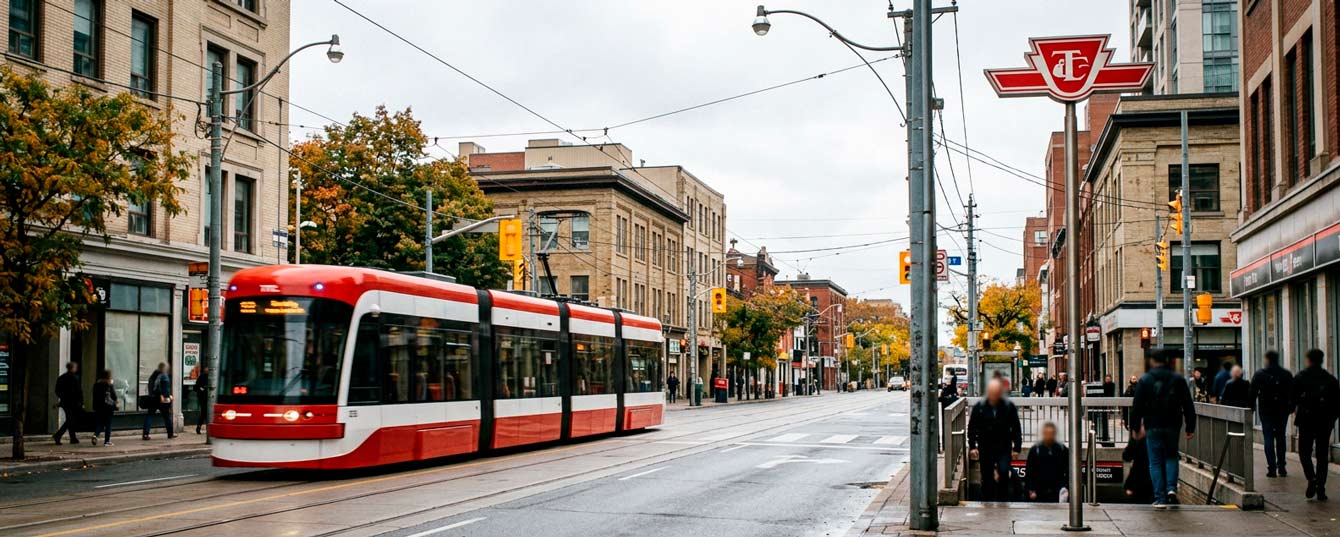
Toronto’s Streetcar Network
Toronto operates the largest streetcar network in North America, with 11 routes spanning approximately 80 kilometres of track. The network carries over 34 million trips annually. Major routes include 501 Queen (one of the longest streetcar routes in North America), 504 King, and 510 Spadina.
The TTC operates a fleet of 264 Flexity Outlook streetcars. These 30-metre vehicles can carry up to 250 passengers (70 seated) and are fully accessible with low-floor boarding. Some routes, like 510 Spadina, run in dedicated lanes with transit signal priority.
Why Does the Distinction Matter?
Understanding transit modes helps explain why different technologies are chosen for different corridors:
- High-demand corridors (like Yonge Street) need subway capacity.
- Medium-demand corridors (like Eglinton Avenue) are well-served by LRT.
- Urban streets with frequent stops (like King Street) work well with streetcars.
- Cost matters: subway costs 5-10x more per kilometre than LRT.
The right technology for a corridor depends on projected ridership, available funding, construction feasibility, and integration with the existing network.
Common Misconceptions
Myth vs Fact
“LRT is just a streetcar.”
Not true. LRT operates on dedicated right-of-way, has higher capacity, runs faster, and has fewer stops. Toronto’s Line 5 is mostly underground – nothing like a streetcar.
“Subways are always underground.”
Not true. Parts of Line 1 run at-grade and on elevated track. The defining feature is grade separation from traffic, not tunnels.
“LRT can’t handle high ridership.”
It depends. LRT can carry 10,000-15,000 passengers per hour per direction. Many world cities use LRT for heavily used corridors. Toronto’s Line 5 is designed for 123,000 daily riders.
“Streetcars are old technology.”
Modern streetcars like Toronto’s Flexity are high-tech, accessible, and zero-emission. Cities worldwide are expanding streetcar networks for sustainable urban mobility.
Transit Capacity Hierarchy (lowest to highest)
Bus → Streetcar → BRT → LRT → Subway → Commuter Rail
Each mode has its place. Higher capacity modes cost more to build but move more people. The goal is matching the right technology to the right corridor.
Learn More
- TTC: ttc.ca
- Metrolinx: metrolinx.com
- American Public Transportation Association: apta.com