
August 2023 changed something specific about Scarborough commutes. Not the route. Not the destination. Just the time spent sitting. When Line 3 died, the 22-minute RT ride became a longer bus trip. Nothing dramatic – an extra 7, maybe 10 minutes. But 10 minutes on a bus is different from 10 minutes on a train. You don’t stand. You sit. You scroll. The phone comes out faster, stays out longer.
This is what 52 minutes on a Scarborough bus looks like in 2026.
52 Minutes on a Bus – How Scarborough Commutes Actually Look in 2026
Scarborough residents lose at least 60 hours a year to longer travel times since the RT shut down in July 2023. Buses replaced trains, and buses crawl.
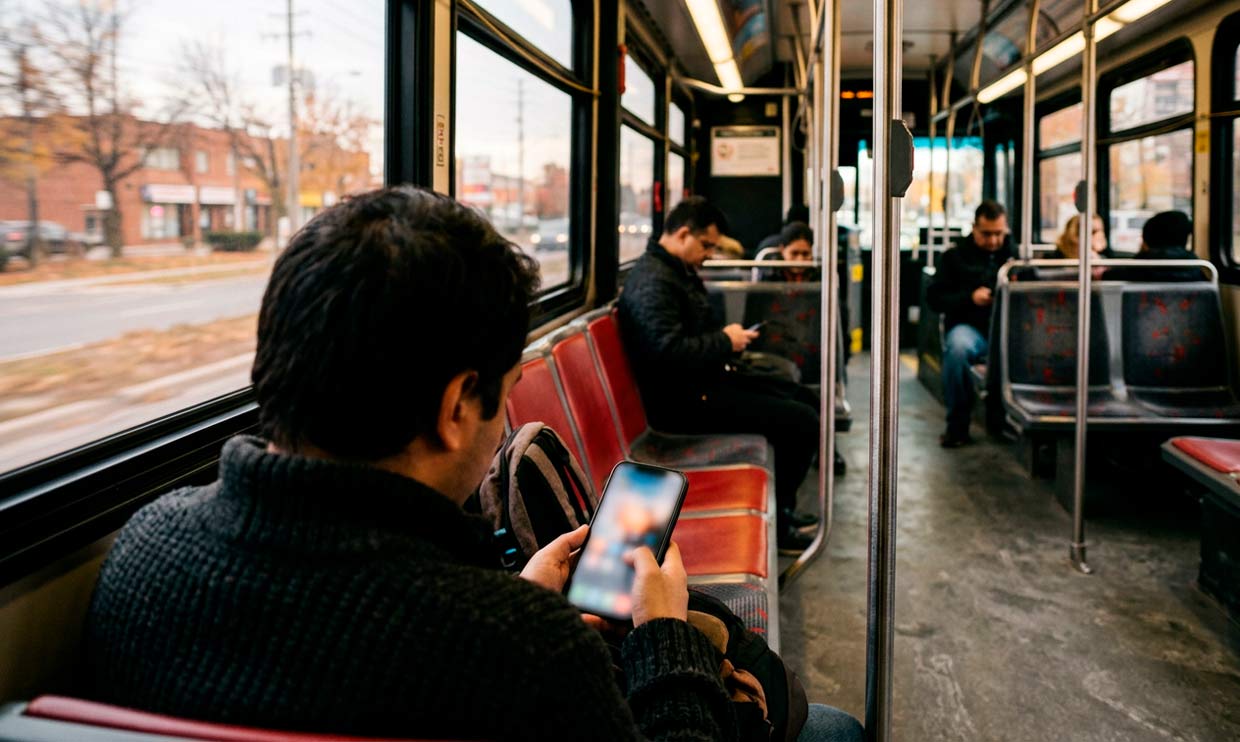
The TTC’s average bus speed dropped from 20 km/h in 2013 to 17.2 km/h in 2024. On-time performance sits at 74% – well below the 90% target. The replacement service between Kennedy Station and Scarborough Centre runs on Midland and Kennedy Roads, taking 22 minutes or more during peak. Add feeder routes like the 38 Highland Creek or 116 Morningside, and you’re looking at 45 to 55 minutes just to reach Kennedy. Transfer. Another 25 minutes downtown.
Buses mean seats. Both hands free. The phone comes out faster than on a subway where you might stand wedged between backpacks.
Mornings Are Slower Than Evenings
Nobody tracks this officially, but morning trips drag. Between 7:30 and 8:45 a.m., buses crawl through school zones – drop-offs, crossing guards, SUVs. A route that takes 38 minutes at 2:00 p.m. takes 52 at 8:00 a.m. More time sitting. More time with a screen.
The Scarborough Busway opens September 2026. The Kennedy-to-Scarborough Centre trip will drop to 15 minutes – 7 minutes faster. But feeder routes won’t change. Those long hauls through residential Scarborough stay long.
Phones Took Over the Commute – And No One Really Noticed
Canadian mobile data usage exploded from 1.5 GB per month in 2016 to 11.0 GB in Q3 2025. CRTC pegged it at 10.95 GB monthly by early 2026, up 7.8% quarter over quarter. That’s not more Netflix at home. That’s commuters burning data on buses and platforms.
What changed? A March 2025 NordVPN study found 73% of Canadian commuters use smartphones during trips:
- 60% listen to music or podcasts
- 50% call or message
- 47% scroll social media
- 33% watch videos or shows
- 25% shop online
- 27% do work tasks
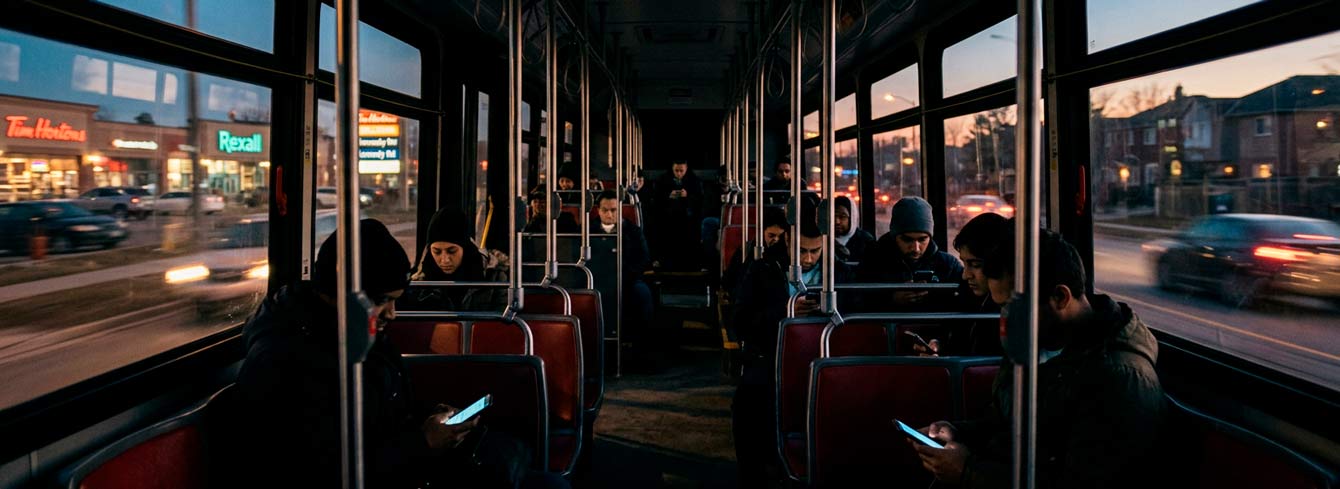
People barely look out windows. Count heads on a packed 116 Morningside at 8:20 a.m. Two riders out of 40 watching the street. The rest – downward faces lit from below.
The TTC killed free Wi-Fi in subway stations in September 2024. Usage dropped 65% since 5G arrived. Only 2% of riders still logged in. Upgrading would cost $17 million. Everyone has data now.
It became normal faster than anyone expected. By 2026, the ride is the screen time.
What People Actually Do on the Bus – From TikTok to Online Casinos
The bus is where people catch up. Messages from overnight. Emails they won’t open at work. A podcast episode half-finished.
Games fit this space. Not console games. Simple interactions – a puzzle, match-three, quick hand of something. Open, play 90 seconds, close. No regret.
Online casinos carved out a piece of this market. Session lengths are short. Connection drops happen. Players bet smaller amounts. Crash and instant-win titles are designed for exactly this – quick-hit excitement between Ellesmere and Lawrence East. Open the app, play two or three stops, close it. The commute continues.
Why Short Sessions Win – Even for Online Casinos
A Scarborough bus ride is fragmented. The 116 stops every 400 metres. Traffic lights. School crossings. Someone pulling the cord last second. Deep focus is impossible. You’d miss your stop.
Popular transit activities tolerate interruption. Social feeds that refresh endlessly. Short videos. Games that save automatically. Mobile casino platforms thrive here – they ask for 90 seconds, not full attention.
Even Video Gets Chopped Up
People start episodes and don’t finish. Scroll past three videos before settling. Watch half, switch. The bus is not a cinema. It’s small windows.
Signal Drops, Dead Zones, and Workarounds
Mobile coverage in Scarborough is patchy. The 86 Scarborough north of Lawrence has a stretch near the rail corridor where LTE drops to one bar. Video buffers. Game freezes. Loading spinner until the bus moves 200 metres.
Across Canada, 15,000 kilometres of major roads, 13.4%, have no mobile service. Mostly rural, but urban dead zones exist. People adapt. Download podcasts at home. Use offline apps. Games that cache content.
The Busway won’t fix dead zones. But the subway extension, opening around 2030, will have cellular built in. No signal loss between Kennedy and Sheppard.
Faster Transit Means Less Screen Time – Maybe
When the Busway opens, the trip shrinks from 22 to 15 minutes. Seven minutes back per trip. Over an hour weekly.
Some screen time will disappear. A 15-minute ride needs less occupation. Check one app instead of three. Look out the window. But habits don’t evaporate. People reach for phones automatically. The time just gets denser – more activity in fewer minutes. Scroll faster. Skip the video. Get to the point.
The Commute Became a Digital Space – Including Online Casinos
Urban planners talk about “third places”, not home, not work. Coffee shops. Parks. The bus used to be one. Now passengers are mentally elsewhere. Group chats. Comment sections. Games.
Every digital service moved in: banking, food delivery, streaming, online casinos. Ontario’s regulated iGaming market pulled in $4.04 billion in 2025 revenue, up 34% from 2024. Licensed operators handled $98.3 billion in wagers. Some on couches. Some at desks. Some on the 86 Scarborough.
Morning commutes are news and messages. Evening is entertainment. The transition from work to home happens somewhere between Kennedy and Scarborough Centre.
What Changes by 2030
The Subway Extension opens around 2030. Three new stations. Seamless ride from Sheppard to downtown. No transfer at Kennedy unless you want one. Those 52-minute bus marathons become 30-minute subway rides for some.
Will phone use drop? Maybe. Subway cars are different – you might stand, crowded, less freedom to scroll. But you’ll still have your phone. Still have 5G. Still have 15 minutes between stations.
Nobody knows if consumption shrinks or gets denser. Technology improves. Connections faster. Apps smarter. The reflex to pull out the phone is wired in.
Scarborough gets better transit. Busway in 2026. Subway in 2030. Faster trips. Fewer transfers. Less waiting.
Whether that means less scrolling or just more efficient scrolling – the data won’t answer for years. The phone isn’t going anywhere. The commute is just getting shorter.